
The Kumbh Mela Myth
The story of the Maha Kumbh Mela comes from the Vedic scripture called Shrimad Bhagavatam. This ancient tale has many inner meanings that are understood by the wise men of India. These stories are sometimes told in song and acted out in dance dramas where children play the many parts.

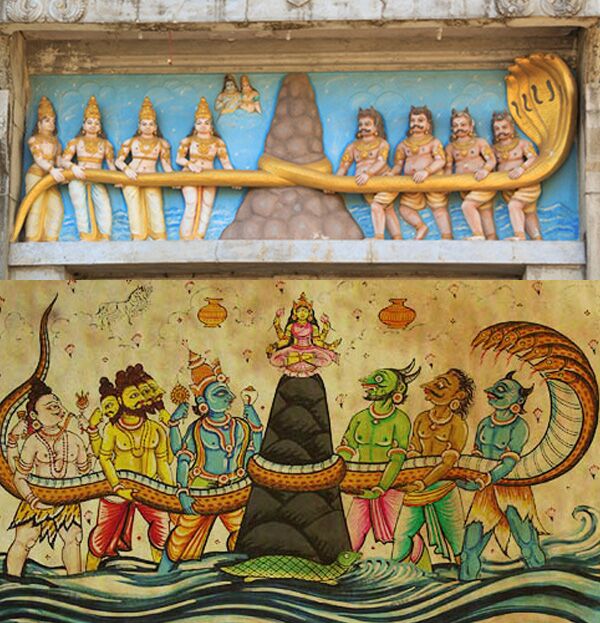
It began when the Devas (Angels) and the Asuras (Demons) decided to cooperate and churn the primal ocean. They were seeking the various secrets that lay hidden within its depths, including the nectar of immortality. They began to churn the rough waters using Mandar Mountain as the churning stone and a giant python named Ananta Naga as the rope which coiled around it. The Devas took hold of Ananta's tail and the Asuras took hold of his head. Each side began to pull creating a huge tug of war.

At first, there were strange smells, noises, and flames roaring out from the depths followed by a deadly poison which started to emerge. Lord Shiva came forth to rescue everyone by drinking the poison before it could destroy the three worlds. After all of the negativity had come forth, the universe was gifted with many great boons. There came a flying horse, a wish giving cow, a priceless jewel, a magic moon, a skycar, a musical instrument, a beautiful dancer named Rambha, and Lakshmi (the goddess of wealth) and Vishwakarma (the mystic architect). Many others followed until Danwantri, the divine healer, appeared holding the nectar, Amrita, in a large jar called the Kumbh.
The Asuras were about to take possession of the Amrita, when Rambha began dancing in such a way as to distract them. Jayanta, one of the Devas, transformed into a large bird and flew off with the Kumbha. Jayanta took twelve days to fly up to paradise where the Amrita would be protected. As he was escaping from the Asuras, he flew over the Earth, stopping at four places. First, Jayanta stopped in Prayag, the old name for Allahabad, which is now called Prayagraj, then Hardwar, Trimbakeshwar (near Nasik) and finally, Ujjaini. At each of these places, some drops of the nectar fell into the river making them each into a holy place of pilgrimage.
Twelve days for Jayanta is twelve years for us, and that is why the mela comes around every twelve years.
There are other versions of this story going around, with some of the names changed from one telling to the next. This is the one I heard at the Kumbh Mela festival.
The churning of the ocean is regarded as a symbol of the ocean of consciousness, which is stirred by the individuals gathering and practicing Sadhana at the Kumbh Mela. As a result, Mela members become the vessel containing the nectar of immortality.